
3D Projection and “Holographic” Display — An Encyclopedia Overview

1. Definitions and Scope “3D projection” in public spaces usually means one of three display families: Illusory (Pseudo-Holography): Uses reflective or semi-transparent media to create the appearance of floating objects (e.g., Pepper’s Ghost, acrylic pyramids, scrims/films). Volumetric: Builds a real volume of light in space via moving surfaces or voxels (e.g., POV hologram fans, swept-volume […]
Scenario-Based Fan Selection | Q&A

Which fans should I choose for high-performance radiators? Use static-pressure fans to push air through dense fins (AIO/DIY rads). Examples: Noctua NF-F12, Corsair ML120 (MagLev), ARCTIC P12. Consider push/pull if space and noise budget allow; seal gaps with gaskets or shrouds to reduce bypass air. Tune curves to water temperature (or CPU package) for steadier […]
Lighting Control & Connector Compatibility | Q&A

What’s the difference between PWM (4-pin) and DC (3-pin) control? PWM (4-pin): The fan receives a constant 12 V, and speed is controlled by a pulse-width signal on pin 4. This enables stable low RPM and, on many models, 0 RPM stop. DC (3-pin): Speed is controlled by lowering the voltage. Most fans need about […]
PC Case Fan Types & Characteristics | Q&A
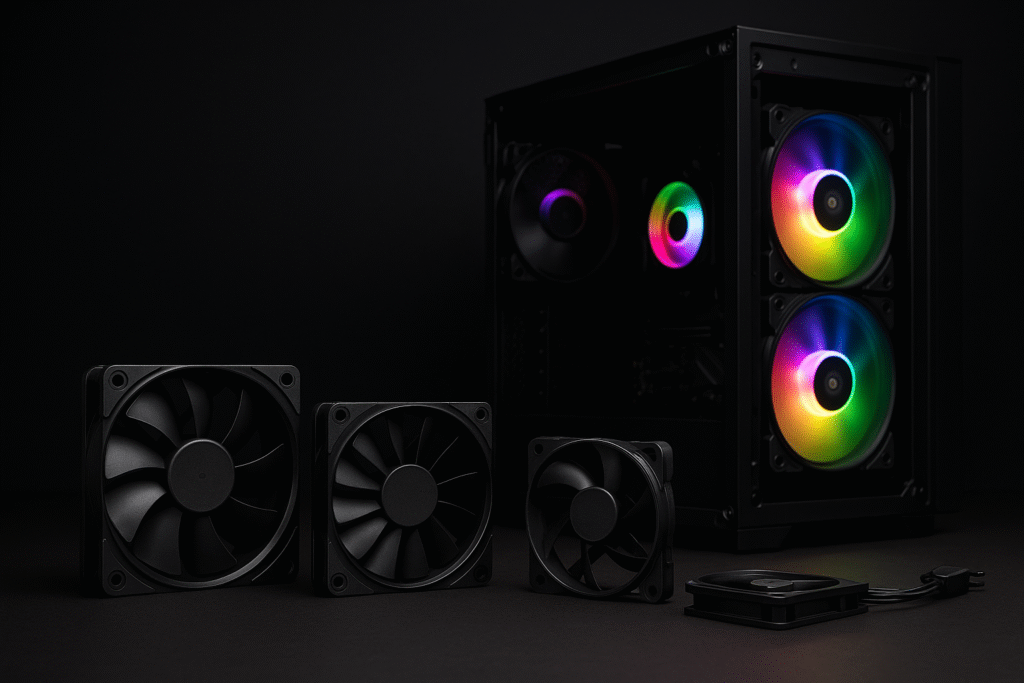
What is an Airflow fan? Airflow-oriented fans have wider, flatter blades and can run at higher RPMs. They’re designed to maximize air volume (CFM), ideal for open intake/exhaust spots (front/side) to rapidly exchange case air and lower overall temps. The key idea is circulation, not fighting resistance (as often noted in be quiet!’s docs).Use cases: […]
Fan Sizes & Bearing Types | Q&A
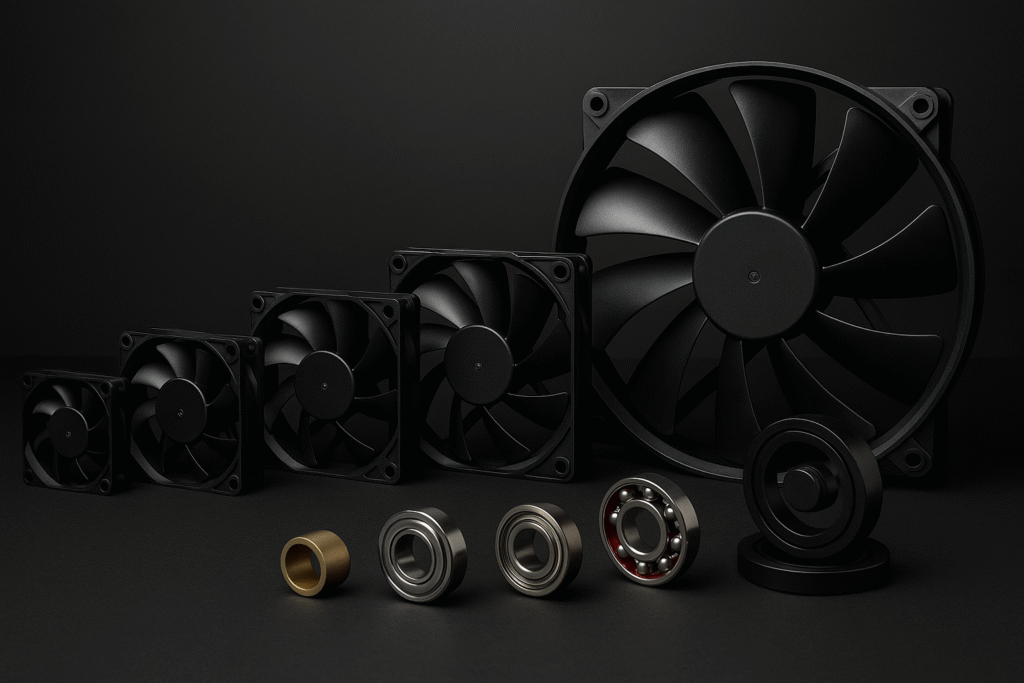
What fan sizes and thicknesses are most common? Sizes: 80, 92, 120, 140, 180, 200 mm (120/140 mm are the mainstream). Standard thickness: 25 mm. Variants: 15–17 mm slim (space-constrained builds) and 30–38 mm thick (higher pressure, better against obstructions—space permitting). Does a bigger fan always cool better? At the same RPM, larger fans usually […]
Fan Placement & Case Compatibility | Q&A

What should I know about front intake? Role: Pulls cool air into the case and feeds the GPU/CPU area. Panel type matters: Closed/solid glass or tight vents: use static-pressure fans to push through filters/grilles. Mesh/open front: use airflow fans to maximize CFM. Maintenance: Clean dust filters regularly to prevent flow loss. How many/size: 2×120 mm […]
